
Quiet is the real luxury
You can have a beautiful home in Bethesda or Potomac and still hear a jet every few minutes from your bedroom. Noise is one of the most common complaints we hear during in-home consultations in Montgomery County, and it rarely gets solved by "better windows" in general. It gets solved by the right glass, the right frame and an installation that leaves no gaps for sound to travel through.
This guide explains, in plain language, how noise-reducing windows work, which ratings actually matter, and what to ask before you invest. It is written by our owner, Yaroslav Marusiak, who has spent more than ten years installing American and European window systems.
Where the noise comes from in Bethesda and Potomac
Most of the noise our clients describe falls into three groups, and each one behaves differently.
- Aircraft from Reagan National. The airport handled about 263,000 flights in 2024, up 4.2% from the year before (FFXnow, 2025). A 2024 change moved more arriving planes over the Potomac River and brought some relief to nearby neighborhoods (WTOP, 2024), but it did not fix noise from departing flights (Washingtonian, 2024). The issue is still active: the Reagan National Community Noise Working Group, which includes representatives from Bethesda and Potomac, continues to meet in 2026 (Metropolitan Washington Airports Authority), and local residents report flights before 6 a.m. and after midnight (Montgomery County Quiet Skies Coalition).
- Highway traffic. Homes near I-495, I-270 and busy roads like River Road and Wisconsin Avenue get a steady, low rumble from trucks and engines.
- Everyday neighborhood noise. Leaf blowers, construction on nearby lots, school traffic and dogs. These are higher-pitched sounds that most decent windows already handle better.
The first two are the hard ones. Jet engines and trucks produce low-frequency sound, which passes through ordinary double-pane glass much more easily than voices or birds. That is why a window that is "good enough" in Rockville may feel disappointing in a home under a flight path.
Rw, STC and OITC: the three numbers worth knowing
Window brochures love the word "quiet." Ratings tell you how quiet. Here is what each one means.
- Rw (Weighted Sound Reduction Index, in dB) is the European test standard, and it's how Oknoplast rates its windows. European windows are built around sound insulation from the start: a rigid multi-chamber frame, multi-point locks and tilt-and-turn sashes that press tight against the frame on all sides. Even the Oknoplast Winergetic Standard reference window is rated Rw 36 dB (Oknoplast), and acoustic glass packages push that higher. Rw is a different scale from STC, so don't compare the two numbers one to one.
- STC (Sound Transmission Class) is the American rating, published by brands such as ProVia, Andersen, Marvin and Pella. It measures how well a window blocks mostly mid- and high-pitched sound, like voices. Higher is quieter.
- OITC (Outdoor-Indoor Transmission Class) measures how well a window blocks low-frequency outdoor noise. It's a better predictor for aircraft and highway noise.
A few rules of thumb help put these numbers in context:
- Most double-pane windows perform around STC 30, which still lets you hear and understand a loud conversation outside. If noise is a priority, Andersen recommends looking in the STC 30 to 35 range (Andersen).
- Near busy roads or flight paths, a 2025 buyer's guide suggests aiming for STC 40 to 50 and OITC 34 to 38 or higher, using laminated or offset glass (Hotian Windows, 2025).
- For aircraft and highway noise, ask for the OITC or a tested Rw value, not just STC, because those ratings better reflect low-frequency sound.
What actually makes a window quiet
The quietest windows combine mass, different glass thicknesses and an airtight frame. Here is how each piece works.
- Laminated glass. A thin plastic interlayer is bonded between two sheets of glass. It is the same type of glass used to soundproof music studios and can cut noise levels significantly (Angi). It is the single most effective glass upgrade for noise, and it also adds security and UV protection.
- Dissimilar glass thickness. When the panes in an insulated unit have different thicknesses, they vibrate at different frequencies and block a wider range of sound (Hotian Windows, 2025).
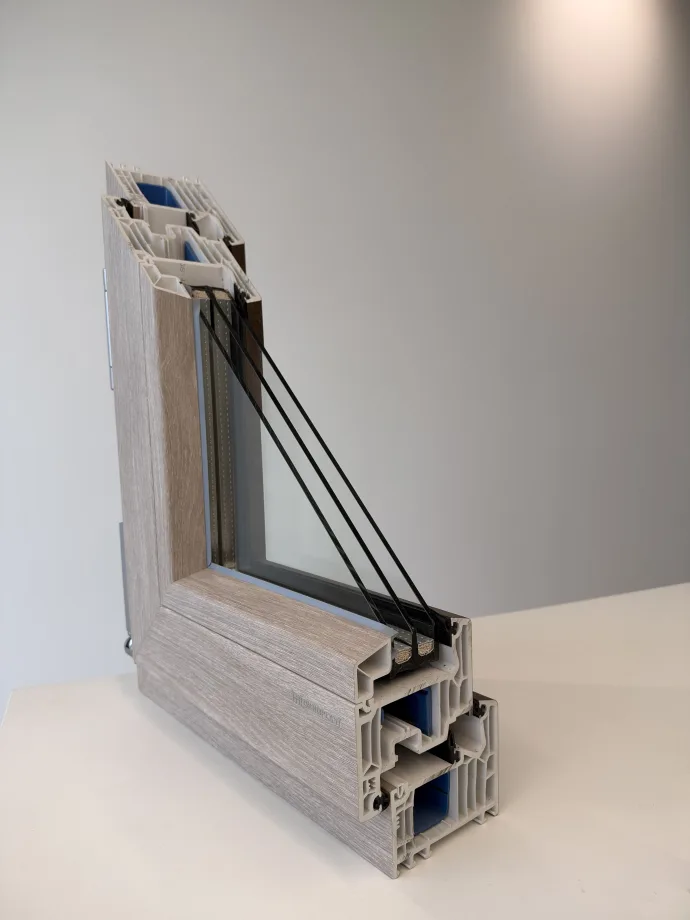
- The triple-pane myth. Many homeowners assume triple-pane automatically means quieter. A third pane helps, but laminated glass, asymmetric thickness and a larger air gap matter more, and many high-performing acoustic packages are double-pane with one laminated sheet (Hotian Windows, 2025). Triple-pane is excellent for energy efficiency; for sound, laminated glass usually does more for the money.
- A rigid, multi-chamber frame. Sound also travels through the frame. A stiff frame with reinforcement and several internal chambers carries less vibration into the room.
- Compression seals and multi-point locks. Even a small air gap lets sound in, so airtight compression gaskets matter as much as the glass (Hotian Windows, 2025). Casement and tilt-and-turn windows that press the sash tight against the frame usually seal better than sliding styles.
Why installation decides the result
A premium acoustic window installed with gaps around the frame will not perform anywhere near its rating. Sound finds the weakest point, and in most homes that point is the space between the window and the wall.
On every noise-focused project, our in-house crew:
- Removes the old window down to the rough opening instead of inserting a new unit into an old frame
- Fills the gap between frame and wall completely with low-expansion insulating foam
- Seals the interior and exterior perimeter so there are no air paths
- Checks that every sash closes evenly and compresses its seals
- Replaces worn trim and caulking so the finished opening is airtight
We never use subcontractors. The same team that measures your windows installs them, which is the only way we can stand behind the result.
Where to start and which windows to consider
You don't always need to replace every window at once. Start with the rooms where quiet matters most, on the side of the house that faces the noise.
- Primary bedroom: the biggest impact on sleep
- Home office: calls and focus during the day
- Nursery or children's rooms: naps and early bedtimes
- Living and family rooms with large glass: big openings let in the most sound
We install several brands, and each has a solid path to a quieter home:
- Andersen: STC upgrade options and laminated glass on select series (Andersen)
- Marvin: laminated and custom glass packages on premium wood and fiberglass lines
- Pella: noise-reducing glass options on several product lines
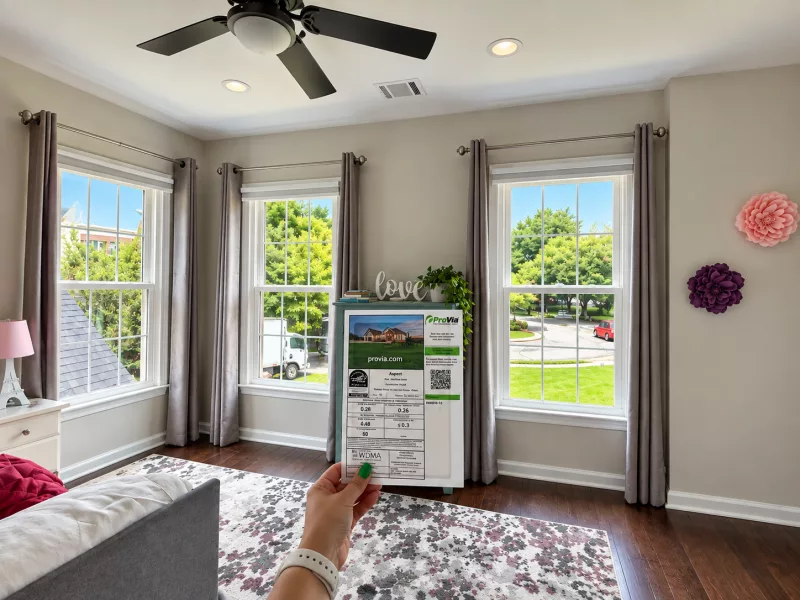
- ProVia: laminated and specialty glass on vinyl replacement windows
- Oknoplast: European tilt-and-turn windows with multi-point locks and tested sound insulation; the Winergetic Standard reference window is rated Rw 36 dB, with acoustic glass available for higher values (Oknoplast)
The right choice depends on your home's style, your HOA rules and how much noise you're dealing with. We'll recommend the glass package based on what you actually hear, not on the most expensive option.
Frequently asked questions
Will new windows make my home completely silent? No window makes a house silent, especially under a flight path. A well-chosen acoustic window can make a dramatic, noticeable difference, often turning a disruptive noise into a faint background sound.
Are triple-pane windows the quietest? Not automatically. Laminated glass or panes of different thicknesses usually reduce noise more than adding a third pane of standard glass.
Do noise-reducing windows cost much more? Acoustic glass does add to the price, and the exact premium depends on the brand and glass package. For comparison, a triple-pane window typically costs 14% to 40% more than a double-pane one (Angi). Because you can upgrade only the rooms that face the noise, the total is often less than homeowners expect.
Can I upgrade just the glass in my existing windows? Sometimes. If your frames are in good condition, replacing the glass unit with a laminated one can help. If the frames are worn or don't seal tightly, the new glass won't reach its potential, and full replacement is the better investment.
Do I need HOA approval? In many Montgomery County communities, yes, especially if the window style or color changes. See our guide on HOA approval for windows and doors in Maryland.
Hear the difference before you decide
The best way to judge an acoustic window is to stand next to one. At our North Bethesda showroom you can compare frames, glass packages and opening styles side by side and ask us anything, with no pressure to buy.
We serve homeowners across Montgomery and Howard County, including Bethesda, Potomac, Chevy Chase and Cabin John. Every estimate is free and lists the exact scope of work, materials and installation method, so you know precisely what you're paying for.